If you’re serious about baking bread, pizza, or pastries at a commercial level, you know that a standard stand mixer just doesn’t cut it. The gluten development required for that perfect crumb and crust demands a machine that can handle heavy dough without straining. That’s where a commercial spiral dough mixer comes in. In this guide, we’ve evaluated three top contenders to help you find the perfect workhorse for your kitchen, whether you run a bakery or just want artisan results at home. We’ll break down what to look for and how each model stacks up.
Choosing the right mixer can be overwhelming with so many specs and features. But don’t worry, we’re here to simplify. We’ve focused on key factors like capacity, mixing technology, and build quality. Our goal is to give you a clear, practical comparison so you can make an informed decision. For more kitchen essentials, check out our cookware collection for other must-have tools.

Pros
- Dual-kneading spiral technology develops stronger gluten networks for superior bread and pizza dough quality
- Removable breaker bar and multi-functional attachments make it genuinely versatile for cakes, cookies, and whipped cream
- 58 speed settings provide precise control for different dough types and mixing stages
- Award-winning design looks modern and professional in any home kitchen
- Significantly more affordable than actual commercial spiral mixers while delivering comparable dough results
Cons
- Premium price point puts it out of reach for casual home bakers
- Requires dedicated counter space due to compact but still substantial footprint
- Steep learning curve compared to traditional stand mixers, may require experimentation to master all features
The Ooni Halo Pro Spiral Mixer is a game-changing appliance for home bakers and pizza makers who are serious about dough quality. This professional-grade stand mixer brings dual-kneading spiral technology directly from commercial bakeries and pizzerias into home kitchens, allowing you to develop the strong gluten networks that separate artisanal bread from ordinary loaves.
What sets the Halo Pro apart is its remarkable versatility combined with precision control. The 58-speed settings give you granular command over your mixing, from gentle folding at 60 RPM to aggressive kneading at over 1,000 RPM. The patent-pending removable breaker bar and four included attachments (spiral dough hook, flexible beater, geared whisk, and breaker bar) mean you can transition seamlessly from dough mixing to whisking cream to beating cake batter without swapping machines.
The build quality reflects its professional heritage and award-winning design. The 7.3-quart capacity is generous enough for substantial batches without dominating your countertop, and the modern charcoal grey finish integrates cleanly into contemporary kitchens. The removable bowl and included splash guard make cleanup straightforward, while the geared whisk and flexible beater attachments feel durable and well-engineered.
The main drawback is the investment required. At this price point, the Halo Pro targets dedicated home bakers rather than casual users. Additionally, mastering all 58 speed settings and understanding which attachment works best for different recipes takes time and experimentation compared to conventional stand mixers.
For serious home bakers and pizza enthusiasts willing to invest in equipment, the Ooni Halo Pro delivers professional results that justify its cost. It's an exceptional choice if superior dough quality is your priority and you want the flexibility to handle multiple baking tasks with one machine.
Capacity: 7.3 quarts
Speed Settings: 58 precision levels, 60 to 1,000+ RPM
Mixing Technology: Dual-kneading spiral with rotating bowl and spiral dough hook
Included Attachments: Spiral dough hook, flexible beater, geared whisk, removable breaker bar
Bowl Type: Removable stainless steel bowl with splash guard and spout
Design Awards: Red Dot Design Award 2025, IF Design Award 2025
Color: Charcoal Grey
Power: US power cord included (region specific)
Best For: Dedicated home bakers, sourdough enthusiasts, pizza makers, and anyone serious about developing professional-quality dough at home. Perfect for those who bake regularly and want to elevate their results.
Consider Alternatives If: You bake only occasionally, have limited counter space, or are looking for a budget-friendly mixer for basic mixing tasks. A traditional stand mixer may better suit casual bakers.
Investment Justification: If superior dough quality directly impacts your baking satisfaction and you value versatility for multiple baking tasks, the professional spiral mixing technology and precision control justify the premium price.


Buying Guide: What to Look for in a Commercial Spiral Dough Mixer
Mixing Technology and Gluten Development
The core of any spiral mixer is its ability to develop gluten efficiently. A true spiral mixer features a rotating bowl and a stationary spiral hook that works the dough from the inside out. This action mimics the gentle kneading of a professional baker’s hands, creating a strong gluten network without overheating the dough. This is crucial for achieving that airy, chewy texture in artisan bread and pizza crust.
Some mixers, like the Ooni Halo Pro, use a patent-pending removable breaker bar to enhance this process, while others rely on a simple spiral hook. Consider how much dough you’ll be making and the type of recipes you’ll use. If you’re making high-hydration doughs, you’ll want a mixer with a robust spiral action that can handle the stickiness without stalling.
Bowl Capacity and Material
Bowl size is a critical factor, as it determines how much dough you can mix in a single batch. Commercial mixers typically range from 10 to 20 quarts. For a home baker or small pizzeria, a 10 to 15 quart bowl is often sufficient, allowing you to mix anywhere from 1.5 to 4 kg of dough. But remember, you can’t fill the bowl to the brim; you need room for the dough to move and develop.
Material matters too. The bowl should be made of food-grade stainless steel, which is rust-proof, corrosion-resistant, and easy to clean. A removable bowl is a huge plus, as it makes adding ingredients and cleaning up much simpler. Look for models with a tilt-head design or a bowl that can be lifted and detached for convenience.
Motor Power and Speed Control
The motor is the heart of the mixer. A powerful motor, typically in the range of 500W or more, ensures that the machine can knead dense dough without bogging down. Look for a gear-driven transmission, which provides more torque and durability than belt-driven systems. Speed control is equally important. You’ll want a mixer that offers a range of speeds, from a slow fold to a faster mix for whipping eggs or cream.
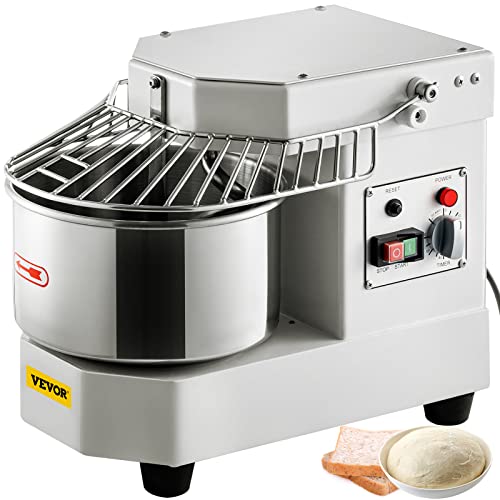
Some mixers offer a surprising number of speed settings, like the Ooni Halo Pro with 58 speeds, giving you precise control. Others, like the VEVOR, have three distinct speeds (low, medium, high) which are adequate for most tasks. A timer function is also a valuable feature, allowing you to set the mixing time and walk away without worrying about over-mixing.
Build Quality and Stability
A commercial mixer needs to be built to last. Look for a heavy-duty construction with a reinforced metal body. The machine should be stable and not wobble or walk on the counter, even when kneading a heavy batch of dough. A heavy base, like the USAJZM’s 86 lb frame, provides that stability and reduces vibration.
Pay attention to the materials used for the gears, pulleys, and shafts. A cast iron pulley and a universal drive shaft are signs of a durable machine that can handle daily use. Also, consider the safety features, such as a secure shield that prevents the mixer from operating if it’s not properly closed. This is essential for any busy kitchen. For more tips on selecting durable kitchen equipment, you might find our guide on carbon steel pans for induction cooktops helpful, as it covers similar considerations for longevity.
Final Thoughts
When it comes to choosing the best commercial spiral dough mixer, your decision should be based on your specific needs. For those who want professional spiral mixing technology with incredible precision and versatility, the Ooni Halo Pro Spiral Mixer is a standout choice with its 58 speed settings and multi-functional attachments. On the other hand, if you need a powerful, reliable workhorse for heavy daily use in a commercial setting, the VEVOR 15Qt Commercial Food Mixer Timing Function offers a robust 500W motor and a large capacity that won’t let you down. Both are excellent investments for taking your baking to the next level.
Frequently Asked Questions
What is the difference between a spiral mixer and a planetary mixer?
A spiral mixer uses a stationary spiral hook that kneads the dough against a rotating bowl, which develops gluten more efficiently and is gentler on the dough. A planetary mixer has a beater that rotates on its own axis while the bowl remains stationary, which is better for lighter mixtures like cake batter and whipped cream. For heavy bread dough, a spiral mixer is the superior choice.
How much dough can a 10 quart spiral mixer handle?
A 10 quart spiral mixer can typically handle between 1.1 and 8.8 pounds of dough, depending on the specific model and the dough’s hydration level. For example, the USAJZM 10.7 Qt mixer can handle up to 4 kg of dough, making it suitable for small bakeries or serious home bakers. Always check the manufacturer’s recommendations for maximum capacity to avoid overloading the motor.
Can I use a spiral dough mixer for other tasks like whipping cream?
Yes, many spiral mixers come with additional attachments, such as a flat beater and a wire whip, which allow you to perform other mixing tasks. For instance, the Ooni Halo Pro includes a flexible beater and a geared whisk, making it a versatile tool for cakes, cookies, and whipped cream. However, the primary function of a spiral mixer is dough kneading, and it excels at that.
What safety features should I look for in a commercial mixer?
Safety is paramount in a commercial kitchen. Look for a mixer with a secure safety shield that prevents operation when it’s not in place. Many models also have an automatic shut-off feature if the shield is opened during operation. Additionally, ensure the mixer has a stable base to prevent tipping. For more insights on kitchen safety and equipment, you might find our guide to saucepans for candy making useful, as it also discusses safety in the kitchen.